
Pilsner Urquell: Which Pallet, Stand, or Refrigerator Sells the Most?
Pilsner Urquell transformed its approach in the saturated Czech beer market by replacing intuition with data, implementing Adastra’s smart shelves and scales in 70 stores across the Czech Republic and Slovakia to track customer buying behavior and drive sales through informed decisions.
unique measuring devices in 70 stores across CZ and SK
increased sales with optimal pallet placement
pallets can be more efficient than stands
The Project Offers Detailed Insight into Customer Behaviour
Thanks to data measurement, Pilsner Urquell are much closer to shoppers’ needs and, together with retailers, are creating a better environment and shopping experience.
The objectives of the three-year project were to:
- Connect data and knowledge of buyer behavior with actual sales data at the level of individual stores’ layout and types of display on the sales floor
- Evaluate the effectiveness of secondary placement on the sales floor according to brand and layout
- Compare secondary placement performance with and without promotional pricing
Thanks to the internal merchandizing standards that Pilsner Urquell have developed based on data collection, the company is able to provide each merchant with detailed information on the secondary placement of specific products.
They get the layout of each store and know exactly:
- Where to place a secondary display stand
- Where to place a pallet
- Where to put a refrigerator
- Which planogram to use to display the goods there
Pilsner Urquell now know the answers to the following questions:
- What is the impact of sales from pallets on total sales?
- Where should the pallets be placed?
- What share of total sales are made from refrigerators?
- Which product saw the highest number of impulse purchases from a POS stand and in which part of the store?
The Best Position on the Sales Floor: Pilsner Urquell Know Where to Place Their Stands
- There are two sales peaks during the day: Pilsner Urquell effectively adjusts visits to merchants accordingly.
- Campaigns are least effective on the day Pilsner Urquell launches them (this has been measured precisely).
- Pilsner Urquell knows campaigns’ exact share of daily sales turnover: the difference in daily sales share is up to 10%.
- Communication at the point of sale should always be localized; the aim is to cover the entire path to purchase.
By collecting accurate data on sales and buyer behavior, Pilsner Urquell has discovered that customers shop where they want to shop, not where the display is.
The producer, therefore, has to meet the customer and offer the product where and when the latter needs it and wants to buy it.
Placing Pallets Strategically Can Boost Sales by Up to 11%
Pilsner Urquell measures the marginal gains of each pallet. They have realized that, by changing the pallet’s location in the store, they can increase sales by up to 11%. This also depends on how many pallets are in the store.
Thanks to data measurement, Pilsner Urquell is further able to:
- Decide when it is worth placing a second pallet – it is not the case that two pallets will sell twice as much.
- Know what the optimal combination of products is on a pallet – the right products in the right place can increase sales by up to 12%.
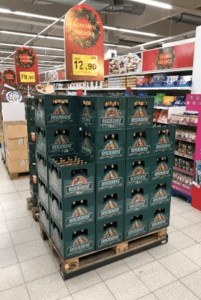
Pallets Outsell Stands by 20%
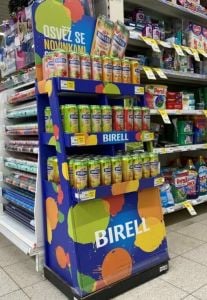
Pilsner Urquell measured peaks in purchasing from stands throughout the day.
Stands sell less. In some locations, they can be up to 20% less effective than sales from pallets.
Compared to pallets, however, they are more conducive to impulse purchases; they can better capture customers as they move around the store and get a taste for the product.
Planogram Tweaks Boost Cooler Sales by Up to 5%
Sales from coolers are far lower than you might expect: at Pilsner Urquell, they found that they were actually up to 80% lower than they had previously thought.
Thanks to their understanding of peak sales on working days and on weekends, Pilsner Urquell know precisely which products are sold from coolers more and which less.
They have adjusted the planogram accordingly and thus increased sales by 5%.
They have measured the actual contribution of each individual cooler and know its marginal gains.
Adastra’s Smart Shelves and Smart Scales Helped Optimize Inventory & Logistics
As part of measuring customer behavior, Pilsner Urquell have implemented integrated multi-sensor devices from Adastra in stores, namely, smart scales under pallets and stands and smart shelves in refrigerators.
More than 150 unique measuring devices in 70 stores across the Czech Republic and Slovakia.
Smart sensors and scales are placed in refrigerators, on stands and on pallets, unnoticed by the customer. Whenever you lift a product, the shelf recognizes it, records the information, and sends it to the application. This can alert responsible store staff in near real-time when stocks need to be replenished. The app also evaluates and analyzes sales trends.
As a result, Pilsner Urquell know, for example, which brand in their product portfolio is selling most and which secondary placement campaign is performing best – in layman’s terms, which product sells best and where.
In addition, smart shelves help better evaluate campaigns, plan new ones, and tailor a completely bespoke offer to the customers of a particular store.