
Data Migration Services

Embrace data migration to modernize your systems, ensuring agility, scalability, and access to advanced analytics capabilities for strategic growth.

Data Migration: The Engine of IT Transformation

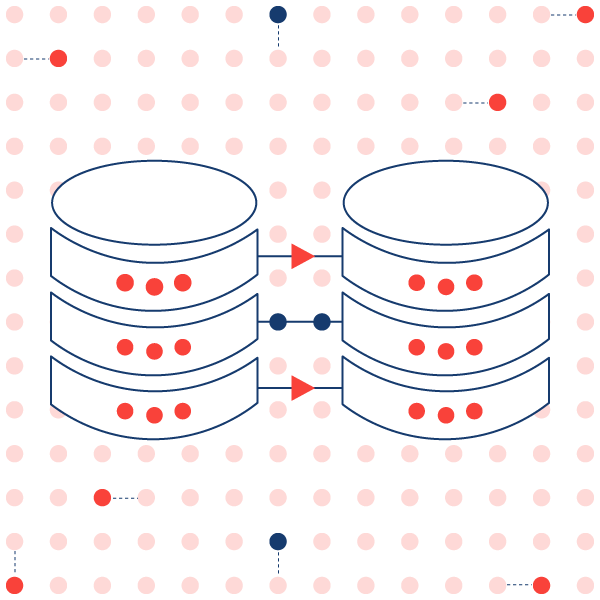
Data migration is a fundamental process involving the transfer of data from one system to another. This transition occurs when upgrading to a new system, consolidating multiple systems, or optimizing data storage solutions. Data migration stands as an essential catalyst for transformation.

The Power of Data Migration in IT Projects

In the realm of IT projects, data migration isn’t just a logistical step; it’s the backbone of digital transformation. It accelerates the adoption of advanced technologies, automates workflows, and reduces operational costs.

Accelerated Digital Transformation

  • Seamlessly transition to advanced systems.
  • Leverage emerging technologies for innovation.

Efficiency Gains and Cost Reduction

  • Automate workflows for streamlined processes.
  • Reduce operational costs and maintenance expenses.

Enhanced Data Quality and Accuracy

  • Cleanse and standardize data for reliability.
  • Ensure consistent data formats for precise reporting.

Scalability and Flexibility

  • Easily adapt to evolving business needs.
  • Handle increased data loads and user demands.

Improved Analytics and Reporting

  • Unlock robust data analysis capabilities.
  • Integrate with advanced analytics tools for better insights.

Data Security and Compliance 

  • Strengthen data protection and compliance.
  • Mitigate risks associated with data breaches.

Customer-Centric Improvements 

  • Enhance customer interactions with real-time data.
  • Improve overall customer experience and satisfaction.

Innovative Opportunities 

  • Explore data-driven strategies and services.
  • Drive innovation in products, services, and operations.

Key Concepts in Data Migration 

Explore the data migration process where data moves seamlessly from one system to another. Learn the basics, discover the tools that enable efficient data migration, ensure data integrity and business success. 

Source System

The original data location, which can be a database, data warehouse, or file storage system.

Destination System

The new data destination, which may vary in format or structure.

Data Cleaning

Ensuring data quality by removing duplicates, correcting errors, and ensuring consistency.

Data Transformation

Converting data to suit the destination system, potentially involving reformatting or restructuring.

Mapping and Matching

Defining how data fields in the source correspond to those in the destination.

Validation and Testing 

Essential for confirming accurate data transfer and operational functionality in the new system.

Mastering Data Migration – The Right Tools for the Job

Discover the arsenal of specialized tools required to effectively carry out data migration tasks.

ETL / ELT Tools

Extract, transfer and load data from the source system while handling various data formats.

Testing and Validation Tools

Verify data accuracy and integrity in the destination system.

Migration Tools

Automate migration tasks like extraction, transformation, and loading.

Data Quality Tools

Ensure data integrity before and after migration.

Mastering Data Migration

Data migration is a complex process that requires careful planning, execution, and validation. It’s a technical challenge and a business one, as it often impacts critical operational areas. Effective data migration ensures that data remains accurate, usable, and secure throughout the transition, minimizing downtime and the risk of data loss or corruption.

1

Data Structure Analysis and Migration Concepts

The fundamental starting point for any successful migration is a detailed analysis of the source structures in source and target systems to understand and identify differences between these structures and their interaction mapping. 

Then we provide data migration concepts to find the optimal path for migrations. This involves moving data from the source system – which includes databases, data warehouses, file storage systems, and various data storage structures – to the destination system, a new location that can support a diverse range of data storage formats and systems. We guide you through this complex process to ensure a seamless transition.

2

Analysis of the Data Lifecycle 

Data in the source and target systems may differ not only in structure, but also in how to work with the data, their life cycle and related processes. Therefore, it is essential to do two-way mapping of the condition of the data and to ensure the consistency and the quality of the new data. 

There may be times during a migration when a new data system declines as it does not meet defined business rules. 

3

Elimination of Low-Quality Data

The goal of data migration is not to clean data as effectively as possible, but to transfer the data, including errors, as faithfully as possible. As the data needs to comply with the requirements of the new system, it must be determined which data is to be used for proper systems operations. 

These controls must be automated and guaranteed in migration tools. Data cleaning is done either automatically as part of the migration tool, or, errors can be identified, categorized, and chosen for manual cleaning. What must be prevented is the situation when new data cannot be loaded because of errors. 

4

Migration Process 

The migration tool determines how strictly the migration is run, how often tests will be repeated and how the whole process is conducted and fine-tuned. 

Individual runs record all errors that arise and the weaknesses in internal control reports in addition to identifying data that must adapt to business rules or which do not meet the quality requirements. This rigorous process ensures all problems are identified and resolved. 

5

Testing and Data Acceptance

An essential component of Adastra Data Migration Framework is a detailed reconciliation check of the data accuracy where the compliance of data between input and output, and the migration between phases, is checked. 

The tool enables the reconciliation of data by defining the complex rules involved in the input systems where data usually have a different structure than in the target system. Comparing and checking the data at this point is far from an easy task.

YouTube video player 1
Success Story

United Bulgarian Bank Merger: On Time and on Budget with Adastra’s Data Migration Engine

KBC Bank set out to perform a complex data migration to unify the systems of United Bulgarian Bank (UBB) and Raiffeisen Bank Bulgaria (RBBG), following its acquisition of RBBG.

800K

accounts migrated

700K

customers migrated

100%

success rate

More Success Stories

Let’s Talk