Podcast
AI Helps Us Scale Change in Schools, Says Tomáš Kaplan from Eduzměna Foundation
July 8, 2026
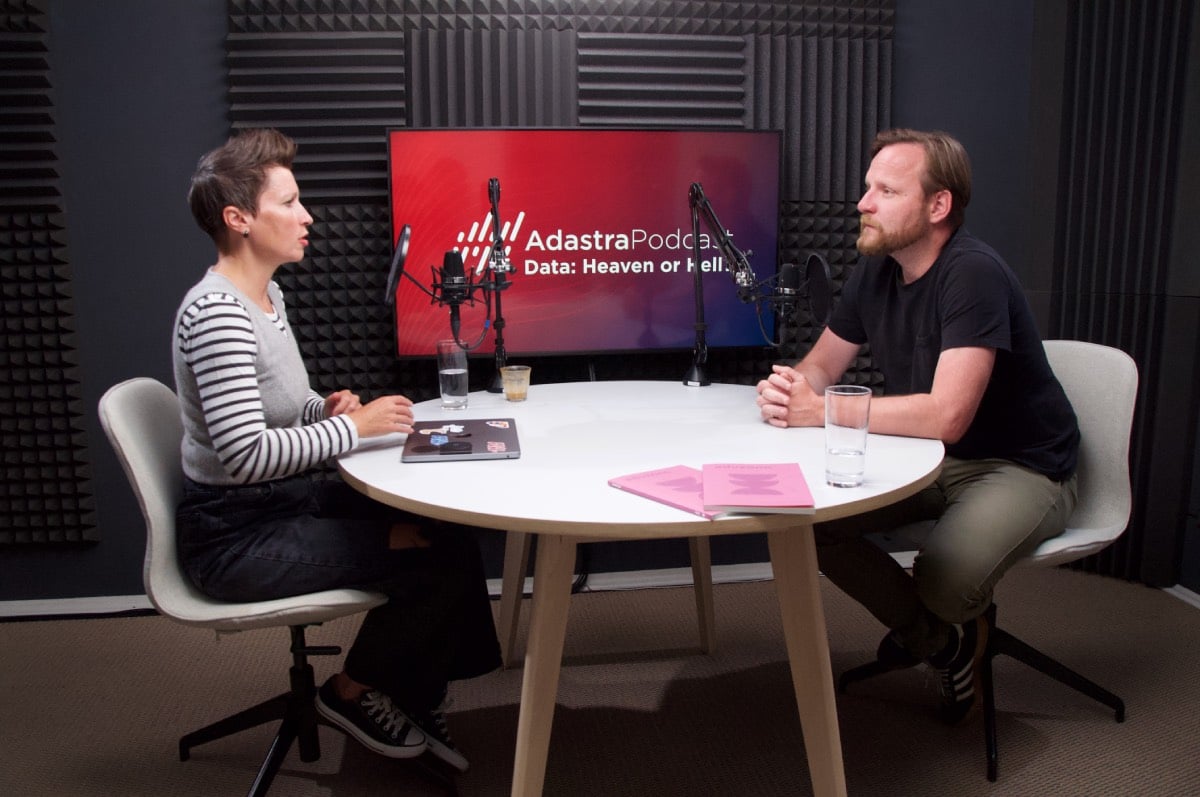
Changing Czech education cannot be done with one decision from above. According to Tomáš Kaplan from the Eduzměna Foundation, real change has to start in the regions, with schools, principals, teachers, parents and local authorities. That is why data and AI are becoming essential. “Without AI or modern technology, we would no longer be able to manage this. We would need a much larger team,” he says in a new episode of Adastra’s podcast.
Watch the interview (in Czech):
Listen to the podcast (in Czech):
In the podcast, Kaplan explains how Eduzměna evaluates a five-year pilot in the Kutná Hora region, where it worked with approximately 60 schools, 850 teachers and 6,000 pupils. In addition to quantitative data, such as the number of schools, teachers, pupils or hours of support, the foundation also processes much more complex qualitative data from interviews, focus groups and feedback from schools.
This is where EduScale Engine comes in. The AI-powered tool is designed to make it faster and easier to analyze interview transcripts, school needs and the impact of different interventions. The project started as a challenge for the European DigiEduHack, where 12 student teams from 42 Prague worked on possible solutions. Adastra supported the challenge from the technology side and helped ensure that the proposed solution would be realistic, scalable and simple enough for regional teams without deep IT expertise.
Eduzměna is now preparing to expand into other regions. In the first wave, 89 regions expressed interest, 20 submitted applications, and the goal is to have a Center for Education Support in every Czech region except Prague by 2028. As the program grows, so does the amount of data that needs to be collected, analyzed and connected into meaningful insights.
How do you measure the impact of systemic change in education? Why is it harder to work with qualitative interviews than with tables of school and teacher numbers? And how can AI help recommend the right type of support for each school’s specific needs?
Read the podcast as an interview
(The interview was shortened and edited using ChatGPT)
Ivana Karhanová: In March 2025, a Czech team of IT developers won one of the main prizes in the European DigiEduHack Global Awards, a competition focused on digital innovation in education. For the Eduzměna Foundation, the team created a tool for advanced data analysis and processing. It will help provide targeted support to schools in the regions. Today’s guest is Tomáš Kaplan from Eduzměna. Hello.
Tomáš Kaplan: Hello.
Ivana Karhanová: Although it may not seem so at first glance, this project is closely connected with data, AI and analysis. Before we get to the technology itself, could you briefly explain what Eduzměna is about?
Tomáš Kaplan: Eduzměna was founded six years ago as a foundation focused on systemic change in education across the Czech Republic. But we do not want to make that change from the top down. We want to build it from the bottom up, through regions. A few years ago, we selected the Kutná Hora region for a five-year pilot, which is now being evaluated. We are now starting to expand into other parts of the Czech Republic and apply the changes we managed to analyze, evaluate and implement in Kutná Hora.
Ivana Karhanová: On your website, you say that you want to change the way Czech schools teach, with the goal of having a positive impact on children. What should that change look like?
Tomáš Kaplan: Very simply, the Czech education system is highly centralized, while each school has its own needs. When you look at the system only from above, you often miss the needs of individual people or individual schools. Eduzměna approaches this from a regional perspective. We try to create an ecosystem of deeper cooperation between schools and all the actors involved in education in a region, so they can share information and good practice.
Ivana Karhanová: You started the project a few years ago in Kutná Hora. What has already been achieved there?
Tomáš Kaplan: Probably the most significant achievement is the creation of the Center for Education Support. It is an active team of people who help schools on their path to change. One key role is the school guide, a person who comes into a school, analyzes its situation, helps define its pain points and then connects the school with methodological support that can address those needs.
Ivana Karhanová: What kind of pain points are we talking about in a school?
Tomáš Kaplan: They can be very different. That is exactly why centralization often causes problems. You may have a very progressive principal and a teaching staff that is less open to change, or the opposite. There may be pressure from parents. Or it may be a catchment-area school with children from more disadvantaged families. All these issues need to be mapped and addressed so that the school knows how to work with them. Czech schools are still very isolated. They compete for pupils, and without someone coming in to map the issues, they often do not know how to solve certain situations because their experience is limited to their own environment.
Ivana Karhanová: From what you describe, the project sounds quite soft, even though the outcomes should not be soft. You need people to describe and share what works and what does not, bring it all together and teach the school how to work with it.
Tomáš Kaplan: Exactly. Eduzměna has set itself a very difficult task because education is an extremely complex system. Many other nonprofit organizations focus on one specific area, such as improving mathematics or literacy. That is easier to measure after a few years. But if you want to improve the school as a whole, you have to look at the entire complex system. That is often about soft factors. The school guide becomes something like a school therapist, and the culture of cooperation turns out to be one of the most important things. Sharing information between teachers, principals, founders and parents helps enormously.
Ivana Karhanová: You mentioned the culture of cooperation. On the surface, it describes how people solve problems together, but underneath it there is data collection. That is where the engine developed during the hackathon comes in. What kinds of data does it need to process?
Tomáš Kaplan: It is an extremely complex task, which is why we entered the hackathon. Without AI or modern technology, we would no longer be able to manage it, unless we had a much larger team. We work with both quantitative and qualitative data. The quantitative data is relatively straightforward: number of schools, pupils, teachers, hours that a guide spends in a school, or hours that a teacher spends in training. In Kutná Hora alone, we are talking about roughly 6,000 pupils, 850 teachers and 60 schools over a five-year period. But the more important part is qualitative data. When a school need is identified and an intervention is introduced, we need to evaluate whether it helped, whether it can be used in practice and where the weak points are. That usually happens through focus groups or interviews.
Ivana Karhanová: So you work with interviews and transcripts.
Tomáš Kaplan: Exactly. And the transcript also has to be understood over time. A teacher may attend a workshop or seminar. Six months later, we ask whether they can use it in practice and whether it helps. But we also need to ask again after a year and a half or two years, to see whether it still works and whether they observe any change. You need to follow the whole path from a simple number, such as ten teachers reaching 250 pupils, to a situation where, after two years, the cumulative impact may reach 600 pupils and the teacher continues the practice or recommends it to others. That becomes a very complex evaluation process because you are working with subjective statements and putting them into context.
Ivana Karhanová: You call the tool EduScale Engine, and this was the tool for which the team received the award. How did it start?
Tomáš Kaplan: It started with our assignment. We are planning to expand into other regions. If you take the numbers from Kutná Hora and multiply them by additional regions, then human capacity is no longer enough. There will always be an evaluator who conducts focus groups and interviews. But the transcript analysis and the analysis of all the findings need to be supported by technology. Our assignment was that we needed help finding a suitable AI tool and architecture that could analyze all this data quickly and with sufficient quality, based on criteria we define in the system.
Ivana Karhanová: When you say architecture, what exactly do you mean?
Tomáš Kaplan: For us, architecture means the path of data collection and the work done with the data afterwards. Inputs come from the field and from many different sources. A school guide may work with eight schools, hold regular meetings, conduct evaluation interviews and analyze needs. We want an architecture where the guide can upload these descriptions into our system, and the system can then help recommend a combination of interventions and support tools for the school so that the support is as effective as possible.
Ivana Karhanová: So it should not only analyze the data, but also recommend next steps based on it.
Tomáš Kaplan: That is the plan.
Ivana Karhanová: So that is the next step.
Tomáš Kaplan: Yes, it should work that way. We are talking about a very fragile system in terms of human capacity. Czech education has limited capacity, and Eduzměna is a foundation and nonprofit project. We cannot build a team of 20 or 50 people to handle everything. At the same time, we need to find the right people in the regions. So we have to make the work more efficient and reduce the pressure on both regional teams and our central team. Without technological support, we simply cannot do that.
Ivana Karhanová: So did you approach 42 Prague?
Tomáš Kaplan: It was more the other way around. There was a European challenge where the hackathon was supposed to focus on education. Through Prague AI, we were asked whether we could bring a meaningful systemic challenge on which the hackathon could be built. At that time, we were deeply involved in our evaluation system and preparing to present the results of the Kutná Hora pilot. We knew how much work was behind it and how long it takes to produce a meaningful result that can be understood not only by experts but also by the general public. So the timing worked very well.
Ivana Karhanová: A coincidence that was not really a coincidence.
Tomáš Kaplan: Exactly.
Ivana Karhanová: So Prague AI informed 42 Prague about the challenge, 42 Prague found you as the organization, and everything fit together. What happened next?
Tomáš Kaplan: We had to prepare the assignment, which was difficult. Eduzměna is not easy to explain in one sentence. We needed to define the challenge clearly enough so that a student from 42 Prague, or anyone joining the hackathon, could understand it and design a solution within 24 hours.
Ivana Karhanová: It is useful to add that 42 Prague is also a nonprofit organization, educating students and people in the labor market so they can find work in IT. Were you assigned a team?
Tomáš Kaplan: We were assigned 12 teams.
Ivana Karhanová: Twelve teams?
Tomáš Kaplan: Yes. It was a 24-hour challenge with 12 teams. We started with an introductory presentation of the project so that the teams could understand the context. We were present during the day to answer questions about Eduzměna and the practical use of the solution. The teams worked through the night. They ordered pizza and kept going for 24 hours.
Ivana Karhanová: How did Adastra get involved?
Tomáš Kaplan: As I understand it, Adastra was a partner of the challenge at 42 Prague. You cooperate with 42 Prague, and Adastra supported this challenge as a partner. There were also people from Adastra on site who could answer technical questions. We could answer questions about Eduzměna and practical use, but it was extremely helpful to have Adastra experts there to guide the teams through the technical side.
Ivana Karhanová: So they kept the project on the right technical track.
Tomáš Kaplan: Exactly. For us, it was crucial to create something that would be feasible, functional and very low-threshold. It must not burden regional teams with complicated software. The interface has to be simple. Ideally, they should be able to upload an Excel file and not worry too much about what happens next, because the system should sort and assign the data correctly. The system has to be very simple. In that respect, Adastra was key for us during the challenge.
Ivana Karhanová: When the inputs are partly soft and the change you are trying to measure is also soft, what is the target output? You measure it, so the result can become quite quantitative.
Tomáš Kaplan: There are criteria for a good school issued by the Czech School Inspectorate, and there are measurable indicators. We can relate the soft data to those criteria. For example, one criterion may involve whether a teacher feels good in the school environment. That can be quantified on a scale.
Ivana Karhanová: How do you quantify that? Through the teacher’s feeling, or through the proportion of teachers who feel good in the school?
Tomáš Kaplan: For example, in that way. Or we know that a teacher is in one of our programs, and we collect feedback on a scale about whether it helps them in their work and whether they are willing to use it. If fifteen teachers say something similar, such as that they were satisfied and use it in practice, you can start drawing a quantitative conclusion from qualitative analysis. At the moment, however, much of this has been manual work: someone has to read the transcripts and connect the findings.
Ivana Karhanová: How do you measure the impact on pupils?
Tomáš Kaplan: That is very difficult.
Ivana Karhanová: Because there are so many of them?
Tomáš Kaplan: It is extremely difficult. In a way, we do not try to measure it directly. Our approach is that if you improve the school environment, the work of the principal and the work of the teacher, then the impact on pupils must logically improve as well.
Ivana Karhanová: So you implicitly assume the impact on pupils.
Tomáš Kaplan: Some things are measured, but it can be misleading. Change in education is long-term. In Kutná Hora, we are already entering the seventh year. During that time, there are children in the system who were not there at the beginning. It is easier to measure impact in kindergartens, often through the parent-child relationship. But in general, we do not fully measure the direct impact on children, because over a long time horizon the data is affected by many factors: children move to other schools, the process takes years, and we may be influencing the development of the next generation more than the current one.
Ivana Karhanová: Can you share some results from Kutná Hora that make you happy?
Tomáš Kaplan: If I put it simply, when people start cooperating and speak openly about what they do, it releases frustration and helps them find solutions together. It may sound like a simple truth, but it really shows that things need to be shared transparently, and that people need someone who listens, offers help and brings a solution. When the school guide listens, proposes a solution and that solution works, it makes a real difference.
Ivana Karhanová: Let’s explain who the school guide is, because the role is quite specific.
Tomáš Kaplan: It can be someone who still teaches, a school principal, or a former teacher or principal. These are people with a strong connection to education and real expertise. Some do it part-time alongside their regular work, while others do it full-time. If a guide works full-time, they can support several schools. If the guide is also an active principal, they usually support fewer schools. The guide is always a local person from the region and always someone who understands education.
Ivana Karhanová: Can you give a few examples of programs so we can imagine what then happens in a school?
Tomáš Kaplan: One major success was the creation of mental health teams. If there is an unresolved problem in a school, it may require a psychologist or another professional to step in. It can involve a child, a teacher, or a relationship between a parent and a child. This is one of Eduzměna’s successes that is easy to explain, because the state has now taken it over and these teams will be established at the regional level.
Ivana Karhanová: So you pushed it from the bottom up.
Tomáš Kaplan: Yes. It was a multidisciplinary team that functioned directly in schools, working with parents, children and teachers.
Ivana Karhanová: Like a local PLC, to use IT terminology.
Tomáš Kaplan: Yes. And now it will serve as a training center for the teams being set up in the regions. On a more everyday level, there are programs that connect principals. They bring principals together so they can share experiences and learn how to be better school leaders.
Ivana Karhanová: One might expect that this already happens naturally.
Tomáš Kaplan: But it does not really happen through sharing. The programs may exist, and a principal can attend them, but if they go alone, only half the work is done. It works much better when they attend with other principals and exchange practical experience. The same applies to methodological centers for teachers, such as a center for history teachers.
Ivana Karhanová: For example, how to teach history?
Tomáš Kaplan: Exactly, how to make teaching more engaging. It is again about sharing good practice from the Czech Republic or abroad. Teachers are very isolated. They often do not have time to look at how things are done in the school next door. Society places enormous demands on teachers: they should be excellent educators, therapists, psychologists and respected authorities for children. There is not enough time. When we take them out of that context and offer a space for sharing, it works extremely well.
Ivana Karhanová: What are the next steps for Eduzměna? Will you launch the engine in September?
Tomáš Kaplan: We have now evaluated the Kutná Hora pilot and presented the results at a conference in Prague in November. The evaluation went very well and showed a significant change. We also had a control sample in another region so we could compare the movement against a more standard region. Eduzměna wants to work in regions that are not Prague. We are interested in an average region, with a typical level of unemployment, wealth, birth rate and social challenges, rather than an elite or extremely disadvantaged region that could distort the data. That is why Kutná Hora was selected.
Tomáš Kaplan: Because the project is successful, we opened a call for other regions to join. The interest exceeded expectations. In the first wave, 89 regions wanted more information. In the end, 20 regions submitted applications. We will select the next regions at an event in Prague on June 18 at Cirk La Putyka. The first wave will be two-phase: three regions should establish Centers for Education Support directly, and another five should receive methodological support first, with the goal of becoming centers later. By 2028, we would like to have a Center for Education Support in every Czech region except Prague.
Ivana Karhanová: Who will maintain EduScale Engine as the number of regions grows? The amount of data and the performance requirements will increase, and that will not be simple.
Tomáš Kaplan: It will not be simple. That is why we are very happy to be able to cooperate with Adastra. Two people from your team are helping us through consultations from the perspective of experienced developers. At the moment, we are also working with two members of the team that won the hackathon challenge. They are building the system so it can be used in the regions.
Ivana Karhanová: Are they graduates of 42 Prague?
Tomáš Kaplan: Yes, exactly. We will fine-tune the system together with Adastra so that we find the most effective, ideally low-cost and low-maintenance solution.
Ivana Karhanová: Those are three things that are difficult to combine, even in the commercial sector.
Tomáš Kaplan: That is true. But as the project grows, we also have to think about adding someone to the team with this expertise. It may not be an education expert, but an IT expert.
Ivana Karhanová: Thank you very much for sharing the information and the journey. Today’s guest was Tomáš Kaplan from Eduzměna. Thank you for coming to the studio.
Tomáš Kaplan: Thank you very much for the invitation.