Insights
Top Data Analytics Companies to Compare in 2026
February 11, 2026
Data analytics companies are transforming how enterprises make strategic decisions in 2026’s competitive landscape. With global data creation reaching 175 zettabytes annually, choosing the right data analytics partner has become critical for business success. Leading data analytics companies now combine artificial intelligence, machine learning, and cloud computing to deliver actionable insights that drive measurable ROI.
This comprehensive comparison evaluates top data analytics companies based on their technical expertise, industry specialization, and proven track record of delivering enterprise-grade solutions. Decision-makers need trusted data analytics companies that can navigate complex data environments while ensuring security, scalability, and regulatory compliance across all implementations.
What Is Data Analytics and Why It Matters in 2026
Data analytics companies specialize in transforming raw data into strategic business insights through advanced statistical analysis, machine learning algorithms, and predictive modeling techniques. These enterprise data analytics providers offer comprehensive services including data collection, cleansing, integration, visualization, and advanced analytics that enable organizations to make informed decisions based on empirical evidence rather than intuition.
The 2026 business environment demands sophisticated data analytics capabilities due to exponential data growth, increased regulatory requirements, and competitive pressure for real-time decision making. Cloud data analytics solutions have become essential as organizations generate 2.5 quintillion bytes of data daily, requiring scalable infrastructure and advanced processing capabilities that traditional on-premises systems cannot handle effectively.
AI-powered data analytics represents the next evolution in business intelligence, combining machine learning, natural language processing, and automated insights generation to provide predictive and prescriptive analytics capabilities. Modern data analytics companies integrate these technologies with existing enterprise systems, enabling seamless data flow and automated reporting that reduces manual effort while improving accuracy and speed of business intelligence delivery across all organizational levels.
How to Choose the Right Data Analytics Partner
Data analytics companies must demonstrate comprehensive expertise across multiple technology platforms, industry verticals, and analytical methodologies to serve as effective enterprise partners.
Top 10 Best Data Analytics Companies in the US (2026 Edition)
1. Adastra
HQ: Toronto, Canada with 22 offices across 8 countries; 2,200+ global professionals
Core services: Enterprise data analytics, cloud data analytics, AI-powered analytics, multi-cloud platform implementation (Microsoft, AWS, GCP), Databricks and Snowflake expertise, real-time analytics platforms
Key differentiators: Premier partnerships with Microsoft, AWS, Google Cloud, Databricks, and Snowflake; 20+ years analytics experience, 500+ enterprise clients served, family-culture approach with reliable delivery focus
Ideal for: Mid-market to large enterprises seeking trusted data analytics partners who prioritize reliable delivery and long-term relationships over traditional big-consulting approaches, perfect for organizations wanting personalized attention with enterprise-grade capabilities
2. Deloitte
HQ: New York, NY with 80+ US locations and 150+ countries globally; 470,000+ employees worldwide
Core services: Strategy consulting, data transformation, AI implementation, advanced analytics, regulatory compliance
Key differentiators: 175+ years heritage, $70.5B revenue, comprehensive regulatory expertise, Big 4 credibility
Ideal for: Large global enterprises requiring strategic consulting with data transformation and regulatory compliance
3. McKinsey & Company
HQ: New York, NY with 130+ offices in 65+ countries; 40,000+ employees globally
Core services: Strategic consulting, AI and analytics, digital transformation, operational excellence, industry expertise
Key differentiators: Premier consulting firm, C-suite access, $16B revenue, AI division with Formula 1 heritage
Ideal for: Large enterprises seeking strategic transformation with executive-level engagement and comprehensive consulting services
4. IBM
HQ: Armonk, New York with offices in 170+ countries; 270,300+ global employees
Core services: watsonx AI platform, hybrid cloud analytics, data fabric solutions, industry-specific AI applications
Key differentiators: 100+ years technology heritage, enterprise AI focus, 19 research facilities, comprehensive compliance
Ideal for: Large global enterprises requiring secure, regulated AI and analytics solutions with enterprise-grade reliability
5. Accenture
HQ: Dublin, Ireland with major US operations across 200+ cities; 784,000+ global employees
Core services: Data strategy, AI implementation, cloud analytics, digital transformation, managed services
Key differentiators: Global scale, $69.67B revenue, 52 countries presence, comprehensive managed services
Ideal for: Global enterprises requiring large-scale data transformation with ongoing managed services
6. SAS Institute
HQ: Cary, NC with global operations; 7,983 employees globally
Core services: Advanced analytics software, statistical analysis, AI/ML platform, industry solutions, data management
Key differentiators: 45+ years analytics heritage, privately held, strong regulatory compliance, comprehensive statistical platform
Ideal for: Organizations requiring advanced statistical analysis, regulatory reporting, and proven analytics software
7. Palantir Technologies
HQ: Denver, CO with global offices; 3,100+ employees worldwide
Core services: Big data analytics platforms, AI-powered insights, data integration, operational intelligence
Key differentiators: Large-scale data processing, government sector expertise, real-time analytics capabilities
Ideal for: Government agencies and large enterprises requiring complex data integration and mission-critical applications
8. Tableau
HQ: Seattle, WA; 70,000+ Salesforce employees globally
Core services: Data visualization software, self-service analytics, embedded analytics, business intelligence platform
Key differentiators: Leading visualization capabilities, user-friendly interface, acquired by Salesforce for $15.7B in 2019
Ideal for: Organizations prioritizing self-service analytics and data visualization capabilities
9. Databricks
HQ: San Francisco, CA with global offices; 8,226+ employees worldwide
Core services: Unified analytics platform, machine learning, data engineering, lakehouse architecture, AI platform
Key differentiators: Apache Spark creators, $62B valuation, lakehouse architecture, collaborative analytics environment
Ideal for: Data-driven organizations requiring unified analytics, machine learning, and collaborative data science capabilities
10. Snowflake
HQ: Bozeman, MT with global operations; 6,000+ employees globally
Core services: Cloud data platform, data warehouse modernization, analytics implementation, data sharing
Key differentiators: Cloud-native architecture, elastic scalability, multi-cloud platform, data marketplace
Ideal for: Organizations modernizing data infrastructure with cloud-native, scalable analytics platforms
Key Trends in Data Analytics for 2026
Data analytics companies are adapting to emerging technologies, and market demands that will define enterprise analytics strategies throughout 2026 and beyond.
Expert Insights: When to Bring in a Data Analytics Partner
Complex Data Integration Requirements
Organizations with multiple data sources, legacy systems, and diverse data formats benefit from data analytics companies’ expertise in data integration, ETL processes, and master data management strategies.
Advanced Analytics and AI Implementation
Companies requiring machine learning, predictive analytics, or AI-powered insights should engage data analytics companies with proven expertise in algorithm development, model deployment, and AI governance.
Regulatory Compliance and Governance
Heavily regulated industries need data analytics companies experienced in compliance frameworks, audit trails, data lineage, and governance structures that meet regulatory requirements while enabling analytics.
Scale and Performance Optimization
Organizations processing large data volumes or supporting many concurrent users require data analytics companies skilled in performance tuning, infrastructure optimization, and scalable architecture design.
Organizational Change Management
Successful analytics adoption requires cultural transformation, user training, and change management expertise that specialized data analytics companies provide through structured adoption programs.
Time-to-Value Acceleration
Companies facing competitive pressure or tight deadlines benefit from data analytics companies’ proven methodologies, pre-built accelerators, and experienced teams that reduce implementation timeframes while ensuring quality outcomes.
Explore Adastra’s Data Analytics Success Stories with Leading Companies
Equipment Energy Cost Optimization Using IoT Data Analytics: Automotive Manufacturer Case Study
Adastra redesigned the energy monitoring and optimization approach for one of the largest automotive manufacturers in Europe. The company faced rising production costs driven by energy-intensive machinery and limited visibility into how individual machines consumed energy during operation. The client’s priority was to reduce energy expenses while maintaining production throughput, Overall Equipment Efficiency (OEE), and product quality. Any solution also had to be implemented without stopping or slowing down ongoing production.
The solution was based on detailed analysis of IoT data collected directly from production machines. Adastra examined energy consumption patterns at machine level and translated the findings into clear, actionable insights for operators and production teams. A cloud-based IoT monitoring solution was implemented, enabling continuous tracking of energy usage and automated adjustments based on real operating conditions. The architecture was designed to fit into the existing production environment, allowing deployment without interruptions and supporting future rollout across additional machines and plants.
The optimized setup delivered measurable results. The manufacturer reduced energy consumption of production equipment by 15%, resulting in significant annual cost savings. These improvements were achieved without affecting production schedules, OEE, or product quality. In addition to lower costs, the client gained consistent visibility into energy usage, better control over operating expenses, and a scalable foundation for energy optimization across multiple sites. The outcome combined financial savings with improved operational discipline and long-term sustainability benefits.
40% Lower TCO with a Modern Data Analytics Platform in Azure Cloud
One of the largest chambers of commerce in North America was running a digital transformation program that included CRM modernization, a new website, and a new financial system. Analytics, however, remained highly manual. Data was exported from Microsoft Dynamics into Excel, where reports were created and maintained by hand. Data stewards spent a disproportionate amount of time collecting, cleaning, and reconciling data, making reporting slow, costly, and difficult to scale.
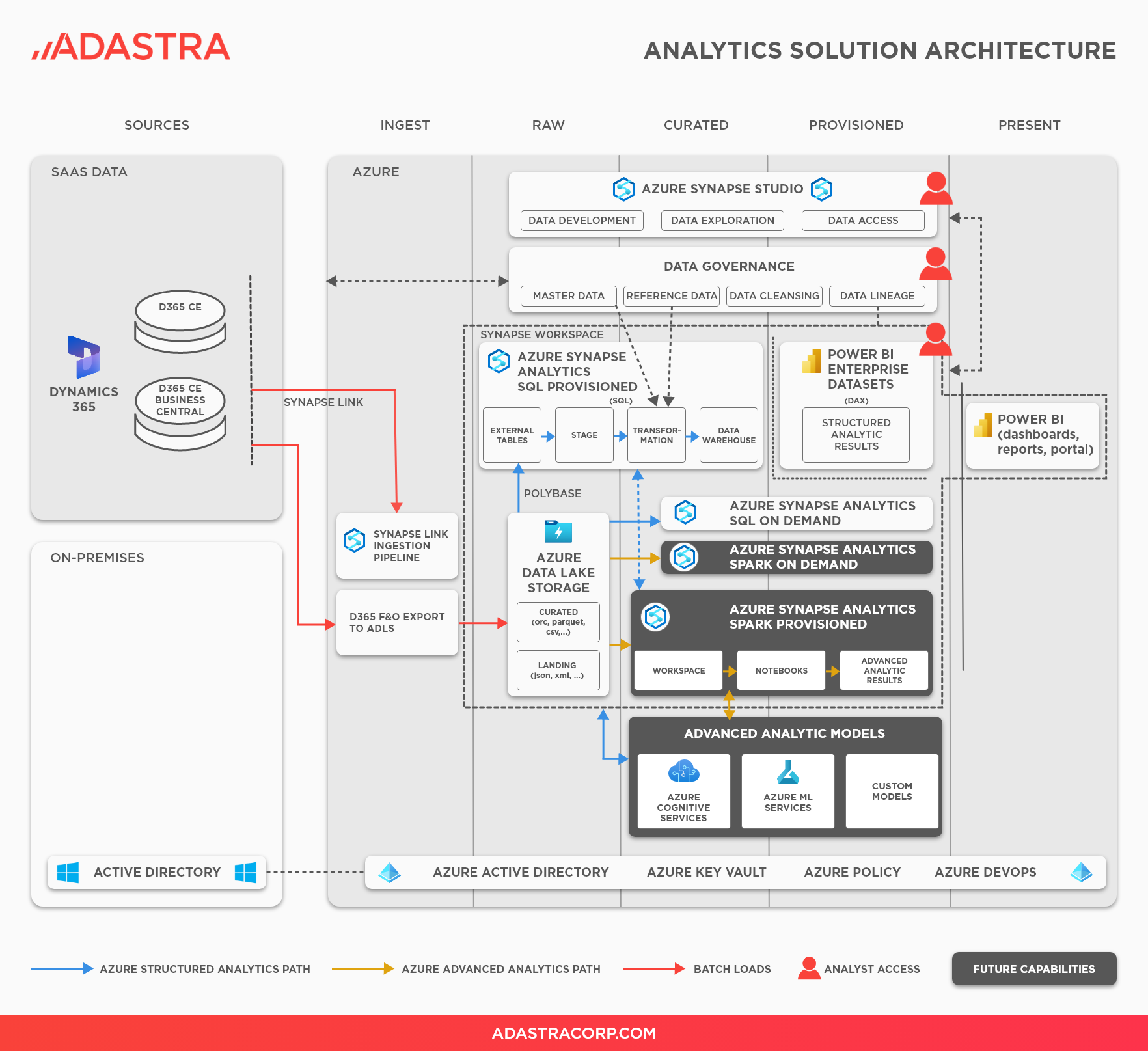
Adastra implemented a Modern Data Analytics Platform in Azure Cloud to centralize data and create a single source of truth. The solution integrated Dynamics 365 and other systems into an Azure-based enterprise data warehouse, using Azure Synapse Analytics and Power BI. Manual reporting workflows were replaced with standardized, real-time dashboards accessible directly by business users.
The results were clear and measurable. The platform reduced Total Cost of Ownership by more than 40%, enabled 3× faster solution development, and delivered 100% cleaned and governed data. Business users gained self-service analytics, reporting cycles were shortened, and the organization established a scalable foundation for future predictive analytics and AI use cases.
Škoda Auto Enables Data‑Driven Decisions with an Advanced Analytics Platform
Škoda Auto, part of the Volkswagen Group, operates a hybrid analytics platform supporting production, logistics, quality, marketing, technical development, and warranty processes. As data volumes and the number of use cases grew, managing data transfers between dozens of on‑premise and cloud systems became a bottleneck. Transfers were manual, difficult to monitor, and required a team of specialists, limiting scalability and increasing operational cost.
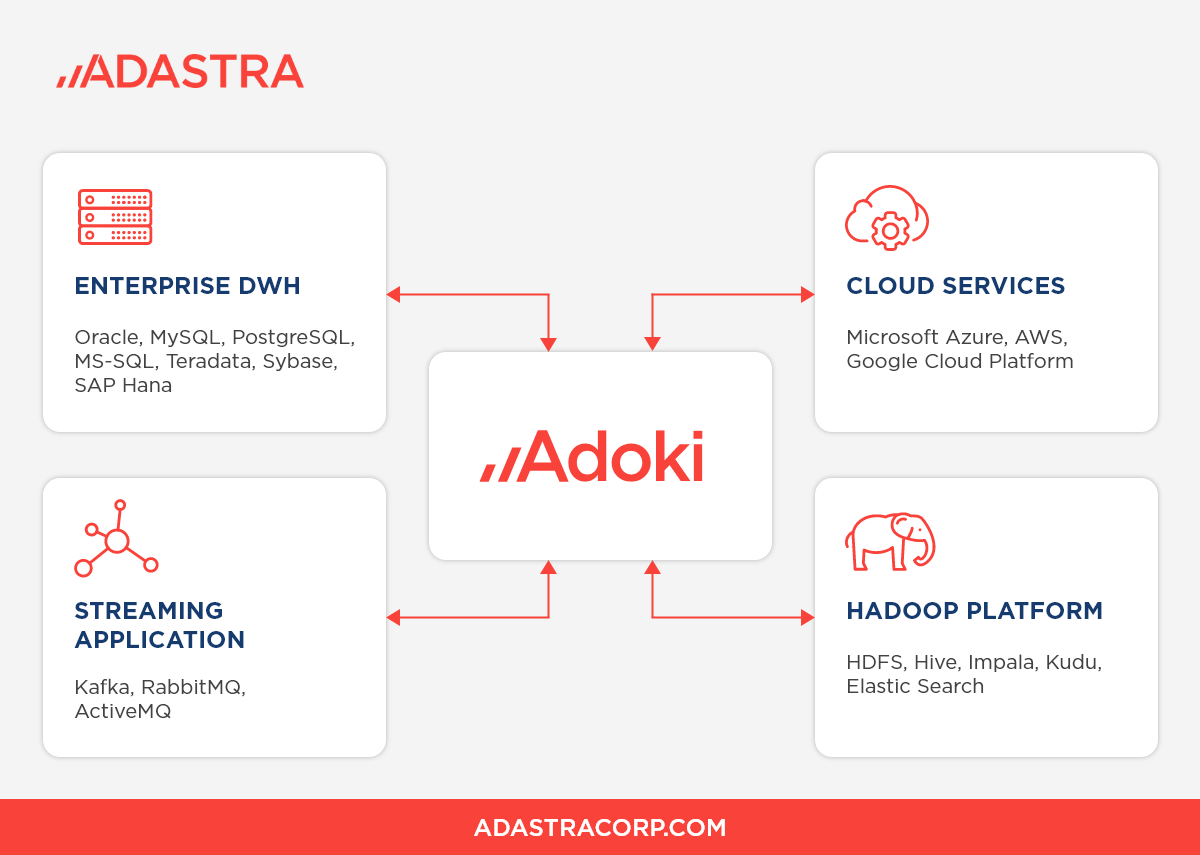
Adastra implemented Adoki as a central tool to manage and monitor all data transfers within Škoda Auto’s Data Analytics Platform. Adoki consolidated multiple ETL tools into a single solution and automated transfers across 40 databases, both on‑premise and cloud. The platform was connected to required data sources in 3 months and now operates across 16 servers with 149 TB of storage capacity.
Today, one IT specialist manages all data transfers. Adoki handles hundreds of GB per month, with an average monthly growth of 1.8 TB, supports 404 users, and performs fully audited transfers multiple times per day. The result is a scalable, cost‑efficient data foundation that supports advanced analytics and AI across the organization.
Adoki is process and cost efficient, and we appreciate that it’s fully automated. It’s also easily scalable, so we’re gradually using it to manage more and more data transfers and increasing volumes of data. It gives us a single location from which to replicate data from multiple systems, the data warehouse, primary applications and more. It can be run by a single data specialist, and the tool alerts them to any changes in the data in the source systems, preventing poor data quality.
– Jiří Boček, Data Analytics Platform Product Owner, Skoda Auto
Conclusion: Choosing the Best Data Analytics Company for Your Business
Data analytics companies selection requires systematic evaluation emphasizing proven industry expertise, technical capabilities, and demonstrated ability to deliver measurable business outcomes rather than generic technology implementations. The most successful partnerships result from careful alignment between organizational requirements, cultural fit, and partner specializations across specific industry verticals and use cases.
Strategic partnership approach positions data analytics engagement as long-term business transformation rather than one-time project delivery, requiring ongoing optimization, user adoption support, and continuous platform evolution that adapts to changing business requirements and emerging technologies. Leading data analytics companies provide comprehensive managed services, performance monitoring, and strategic consulting that extends well beyond initial implementation.
Risk mitigation remains critical given that 60% of analytics projects fail to deliver expected ROI due to poor partner selection, inadequate change management, or insufficient user adoption strategies. Experienced data analytics companies employ proven methodologies, comprehensive testing procedures, and structured adoption programs that ensure successful transformation while protecting existing business operations.
Future-proofing considerations address emerging trends including generative AI integration, real-time analytics capabilities, and privacy-preserving technologies that will define next-generation analytics platforms, requiring partners with innovation commitment and strategic technology vision.
Transform your organization’s decision-making capabilities with Adastra’s proven data analytics expertise. Our certified data scientists and analytics architects deliver measurable ROI through comprehensive data strategy, advanced analytics implementation, and ongoing optimization services.
Contact our analytics experts today to schedule a complimentary data readiness assessment and discover how leading data analytics companies accelerate business growth through intelligent data-driven insights and strategic technology partnerships.