Podcast
Andrea Líbezná (T-Mobile): Enhanced and More Diverse Outputs in Less Time – ChatGPT Fosters Creativity
August 30, 2023
Looking for campaign inspiration that captivates customers during the off-season? Spending hours searching for the right words for an email? Need to craft a presentation for thirty people but presentation skills aren’t your forte? These are common challenges for marketers and beyond. “In the workplace, it’s often a day-to-day race, and ultimately, you’re swamped and need assistance. ChatGPT saves me a lot of time,” says Andrea Líbezná, Senior Digital Specialist at T-Mobile.
- What approach did the company take to integrate AI tools into their operations?
- How did T-Mobile, with the aid of ChatGPT, manage to increase the traffic to its app even without enticing offers for customers?
- What principles should be followed when writing prompts in ChatGPT to obtain relevant results?
- How will client expectations from creative agencies likely change under the pressure to adapt AI tools?
Listen to the podcast (CZ)
Read the podcast as an interview
Ivana Karhanová: We’re on the lookout for a colleague who excels in leveraging ChatGPT within the business realm. The key requirements are the ability to craft compelling prompts and effectively brief team members. Agency experience is a plus. This could be how the job listing reads when seeking someone adept in the corporate world with artificial intelligence and language models. And that’s why today’s guest is Andrea Líbezná, Senior Digital Specialist at T-Mobile, known for her proficiency with ChatGPT. Hello.
Andrea Líbezná: Hello, thank you for the invitation.
Ivana Karhanová: What is ChatGPT currently doing in T-Mobile, at least in your team?
Andrea Líbezná: I’m from the Digital tribe, the digital team. And how do we use artificial intelligence today? For instance, in my role, ChatGPT is a great starting point when someone is unsure about a campaign or mulling over something. Instead of spending a lot of time on it, one simply opens ChatGPT, inputs their dilemma, simplifying it a bit, and initiates that first interaction when they need to spark an idea.
Ivana Karhanová: You mentioned campaign preparation. We talked about a post-Christmas campaign, where you said the goal was to maintain user engagement. Essentially, to keep them using the app, even though the festive season was over. What did you input into the tool then?
Andrea Líbezná: It’s quite funny because I’m not a creative, I’m not a copywriter. Of course, I have colleagues for that. But we had this initial brainstorming session, and I was thinking about what I could bring to the table that would be valuable and make sense. It ended up resonating really well, and I just started writing simply: Look, I have this problem. Our huge quarterly campaign has ended, and now I need to drive engagement, create new activity for people using our app to keep them coming because we currently don’t have any specific offers. We are just planning the next quarterly campaign, so what do you suggest? And then the ideas started flowing. One after another. And if I wasn’t satisfied, I’d just write: Give me more ideas. And it started to spark from there.
Ivana Karhanová: Did you have to refine these ideas?
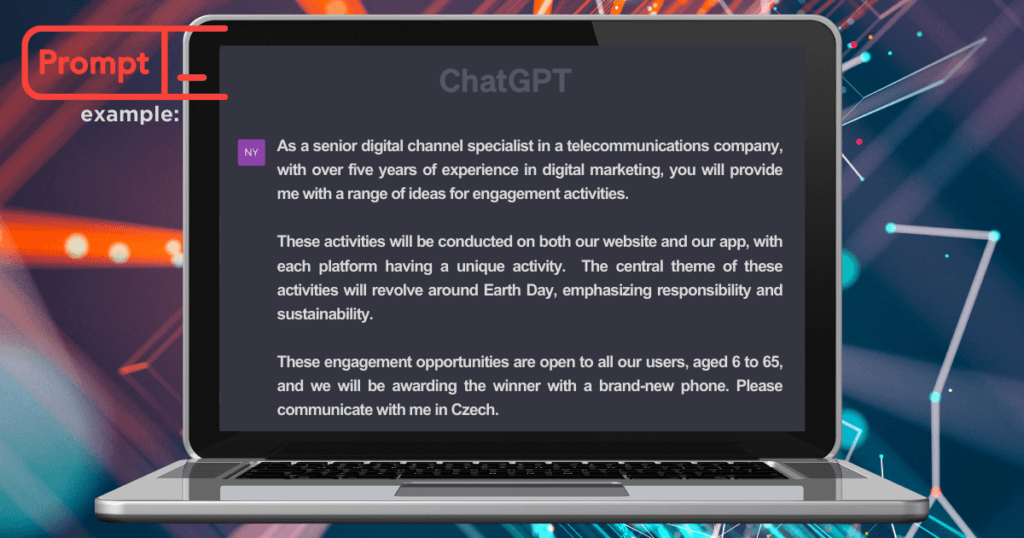
Andrea Líbezná: Yes, definitely. I was refining them. Initially, my approach to prompts was just about starting a conversation – a question here, a question there. As I got more interested in this world, I began to educate myself. I attended workshops and learned about different ways to achieve the results I expected. I have expectations, so my prompts gradually evolved from two lines to, say, a paragraph. I often start with describing my position, what I can do, what I’m responsible for, but also sometimes I add to it. I won’t lie, sometimes I just spell out: Look, I’ve been in this background for several years and I want it to look like this. So, the prompt becomes longer and more detailed. The more specific it is, the better the results, and that, I believe, is the key.
Ivana Karhanová: Going back to the campaign we discussed, T-Mobile had a major campaign over Christmas. After it ended, you mentioned needing to keep people engaged with the app, possibly for further reselling/upselling and so on. So, what did you ultimately derive from ChatGPT?
Andrea Líbezná: To generalize, T-Mobile typically runs four major campaigns throughout the year, including the Christmas and summer campaigns, and others like Back to School, followed by an awareness campaign at the start of the year. Naturally, these vary annually. Most often, people come to our app to pay their bills, a solid reason. Over 80% of our customer base uses the app monthly for this. We wanted to maintain contact with them beyond these billing days, which occur only once or twice a month. From the chat, we got the idea of how people set New Year’s resolutions. What we found appealing and novel, leading us to pursue it, was launching a self-care activity. It wasn’t about promoting a product or service but purely about agreeing to run a five-week challenge, recommending weekly activities for individuals to see if it would interest our customers, whether they would visit the app for this, and whether our marketing support was minimal. I must say, it was a tremendous success.
Ivana Karhanová: So, the idea came from ChatGPT in a general sense, and then you refined it further, or did you also use ChatGPT for additional work on the campaign?
Andrea Líbezná: Initially, it was a general idea. At the start, during brainstorming with colleagues, we discussed which direction to take, which was very similar. So, the general themes, the direction to pursue. Once we agreed as a team on the direction, I then used ChatGPT to further refine the details, considering what each week could involve. We also discussed these details with colleagues. From my experience, in the end, we, the employees, along with my colleagues, are truly responsible for deciding what to use from it and in which direction to proceed.
Ivana Karhanová: Maybe it would be worthwhile to elaborate on your role at T-Mobile. What exactly are your responsibilities, especially now as you’re planning campaigns with ChatGPT?
Andrea Líbezná: I am part of two teams, and in the team where I started using ChatGPT at the beginning of the year, it’s the engagement and upsell team. This team focuses on customers who already use our services, and we aim to maintain contact with them through various engagement activities. Essentially, we want customers to keep coming back, not just to open the app and make payments, but to find enjoyment and value in visiting the app voluntarily.
My second team is focused on acquisition, where I am currently responsible for our young customers, aged six to twenty-six – essentially the student campaigns. I must admit, in this area, I have not yet utilized ChatGPT.
Ivana Karhanová: And why is that? Any idea?
Andrea Líbezná: In the workplace, we often operate on a day-to-day basis, which can lead to an overwhelming amount of work needing assistance. With ChatGPT, I save a lot of time. I started using it to expedite tasks, helping me to initiate the copywriting process with my colleague, who handles web and app copy. She, of course, also has a lot on her plate, so I wanted to facilitate her work by guiding her effectively, which led me to start using ChatGPT. As for why I haven’t used ChatGPT in my second team, I honestly don’t know. I could say it’s due to lack of time or because we are already ahead with our planning, but I feel it’s more about timing coordination. In my acquisition team, colleagues are using ChatGPT. Interestingly, this summer, we launched a major campaign from Deutsche Telekom, our parent company, specifically targeting Generation Z. It’s a fascinating group, very different from us. I have a colleague who belongs to this group and before coming up with a UX proposal, he consulted ChatGPT for advice on visuals and current trends. Based on this, he was able to refine his proposal and support it with strong arguments on which direction to take, which is fantastic.
Ivana Karhanová: Where else do you personally use, not to say artificial intelligence in its strictest sense, but language models?
Andrea Líbezná: Besides ChatGPT, I’ve experimented with DALL-E for text-to-image generation. I still use Poe, which is fantastic, especially if you have an iPhone or generally use iOS. It aggregates multiple language AIs, each with different functions and capabilities. Some help with coding, others allow you to input up to sixteen hundred points of text, so you can pack in a lot of content. It also includes the latest ChatGPT-4, capable of interacting with real-time data we have. These are the tools I use. Often, I use them in conjunction with each other, like using ChatGPT to prepare prompts for Midjourney. It’s great to cross-utilize them in this way. From a different angle – I also use it for emails. Sometimes I struggle with crafting a reply for an hour and don’t know how to phrase or pitch something better, so I seek advice. I must say, I then finalize it in some way. I’ve even received feedback like: “That’s really well-written. It made me happy.”
Ivana Karhanová: How long does it take you, or how many prompt iterations or adjustments do you need, to get the desired result from ChatGPT?
Andrea Líbezná: I must say, initially, it was quite a task, but definitely worth the time investment. In the beginning, I could spend hours on it. Now, I have saved the prompts that work for me, using them with copy-paste, and it takes just minutes, sometimes even seconds, which is thrilling. As we discussed earlier about the engagement activity in January, it was a great initiative and felt good to present to others what we had achieved. Naturally, preparing a presentation is a big pain for me. However, with ChatGPT, it’s been incredibly fun. I briefed it at the start, saying: Here’s my presentation, I need this, this happened, and I need to convey it to thirty people in a meeting. We went through it slide by slide. It beautifully transformed my text into five clear, concise bullet points. And what was absolutely perfect for me was adding a quote at the end. Being honest, if I had searched for a quote online that encapsulates the context of the whole activity, it could have taken me weeks, but with ChatGPT, I just mentioned that we had done a presentation together and now I wanted to conclude it with a motto or quote. It started throwing out 5, 10, 20 quotes from different time periods by various people, allowing me to choose. It matched the theme perfectly. Within an hour, I had made my selection and forwarded the presentation.
Ivana Karhanová: How do your superiors and the team as a whole view the use of AI and ChatGPT?
Andrea Líbezná: In our team, and broadly across the digital sector, the use of AI, particularly ChatGPT, is positively perceived and supported. Just last week, I noticed new e-learning opportunities were introduced, so individuals can choose webinars even in foreign languages to learn a lot of new things.
Ivana Karhanová: So, T-Mobile is actively educating you internally on these topics?
Andrea Líbezná: Exactly. I’ve already participated in several webinars and often encountered people from other companies. Some still strictly prohibit it, which frankly gives me the chills. One of my first webinars was quite eye-opening for me. It included an agency representative showing examples of how they are using it and the direction they’ve taken. I was fascinated, and I got to that workshop partly because my boss was also enthusiastic about it. She said, “Go there, then share what you’ve learned with us.” So, we had a team meeting afterwards, and people are excited about it. Not everyone is fully aware of what it entails. I wouldn’t dare say that everyone has that knowledge, but in the digital sphere, people definitely know about ChatGPT, and no one is stopping them from further educating themselves.
Ivana Karhanová: We touched on agencies. Looking at the collaboration between corporates like T-Mobile and various communication, creative, and advertising agencies, everyone seems to be “competing” in how they can leverage ChatGPT’s capabilities. What do you, as a client, realistically expect from them?
Andrea Líbezná: Given my background in advertising agencies, I have an overview of the teams, their functions, and how much time they spend on tasks. With ChatGPT, I believe we’ve reached a point where, as a client, I would expect an agency to show more proactivity, offering a variety of proposals derived from the given brief. I deliver a basic brief, and then I expect from the agency not just one proposal, but several. I anticipate a deeper dive into the problems or creativity of the copy. Essentially, I’m looking at it from the perspective that the approach should be much broader.
Ivana Karhanová: It occurs to me that what you’re saying might mean you’re placing higher demands on these agencies than before.
Andrea Líbezná: It’s true. On one hand, it might seem like that, and with the advent of AI, there’s a fear of job security. However, I’m among those who believe it will actually aid our work. If properly harnessed, AI can expedite many tasks and processes, enhancing creativity. That’s what I expect from an advertising agency. Perhaps it’s because of my own experience, or because I support this integration, but I think there should be someone in the agency closely connected with AI. More importantly, there should be no shame in this. We should be able to acknowledge – I sourced the basics from ChatGPT or sought advice from it. Being open about it is crucial.
Ivana Karhanová: So, you’re saying that rather than seeing agencies saving “work” with ChatGPT that they could bill to clients, you envision them delivering a greater volume of proposals, allowing clients to have a broader selection to choose from, and the cost for these hours would be the same as before, but the range of options would be wider?
Andrea Líbezná: Exactly, that’s my point. Just this weekend, I had the chance to earn a certificate on AI for free on LinkedIn, which I would definitely recommend. It’s about four hours long. I’ve completed it, and at least three speakers mentioned something I strongly agree with: AI finally gives us the opportunity to utilize our creativity fully. It allows us to focus on what makes us unique as individuals. That’s exactly the essence of it.
Ivana Karhanová: Do you remember the first prompt you entered into ChatGPT?
Andrea Líbezná: I believe I started with jokes, and something that hasn’t come up yet is that I still use ChatGPT in English. Czech isn’t crucial for me at the moment, and I place more importance on English because the data are of higher quality and more plentiful in that language. So, I began with jokes, then moved on to creating my LinkedIn bio, and gradually, ChatGPT became a friend to me. I found a kindred spirit with whom I could exchange and share my thoughts, and it was wonderful. We spent weekends together.
Ivana Karhanová: Your partner at home must have been thrilled, right?
Andrea Líbezná: Luckily, he’s just as crazy about it as I am. I think he’s even a step ahead. He’s been involved for longer and has more experience than I do.
Ivana Karhanová: That was Andrea Líbezná from T-Mobile sharing her ChatGPT experiences. Thanks a lot for sharing, and see you next time.
Andrea Líbezná: Thank you for the invitation, and have a great day.