Insights
The Most Common ESG Tools for Czech Companies are Paper, Pencil and Excel
May 3, 2024
Czech companies are in the initial stages of digitizing ESG data. So far, the focus has been on strategy, process design and data collection. A notable concern among these companies is the lack of examples of best practices in the market. These insights, among others, were highlighted in a recent survey conducted by Adastra.
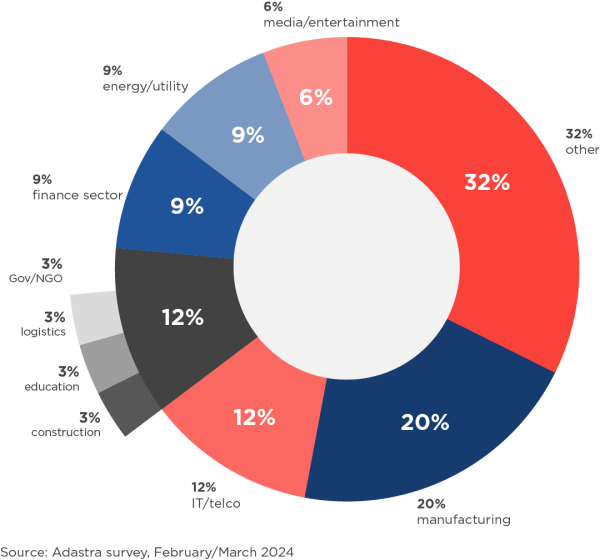
Respondents to Adastra’s survey represent various industries. Most responses came from the manufacturing sector (20%), followed by IT/telco (12%), energy and utilities (9%) and financial sector firms (9%). A total of 32% of respondents said they came from another sector, specifying examples including retail and consulting.
There is a growing interest in “ESG-friendly” companies
Corporate management needs ESG data for decision-making, planning and forecasting. “Companies that have already started collecting ESG data have a big head start. Organizations won’t be able to conduct business or meet the mandatory ESG agenda without quality and reliable data,” says Radim Petratur, ESG Competency Lead, who covers the topic of ESG data digitalization at Adastra.
According to him, companies should start looking at ESG as a competitive advantage that will help kick-start new business. In fact, there is a growing interest in “ESG-friendly” companies.
“Although it may seem for now that only selected companies are made to do ESG reporting, soon medium-sized or even smaller ones will also be required. First, European legislation will come into force which will expand the portfolio of companies required to report. At the same time, smaller companies are also suppliers to bigger ones. And these will soon require their suppliers to comply with ESG standards,” says Radim Petratur, pointing out that European standards will gradually impact global business. “European companies have suppliers all over the world. And those will also have to align with the regulations. Failure to do so will result in a worse ESG scoring and their European customers will be at a disadvantage and will look elsewhere.”
Czech companies are in the beginning phases of ESG data digitalization
How are Czech companies doing in the process of ESG data digitalization? The survey showed that big Czech companies are aware that ESG reporting is not just a one-off task and that they will have to address the ESG agenda.
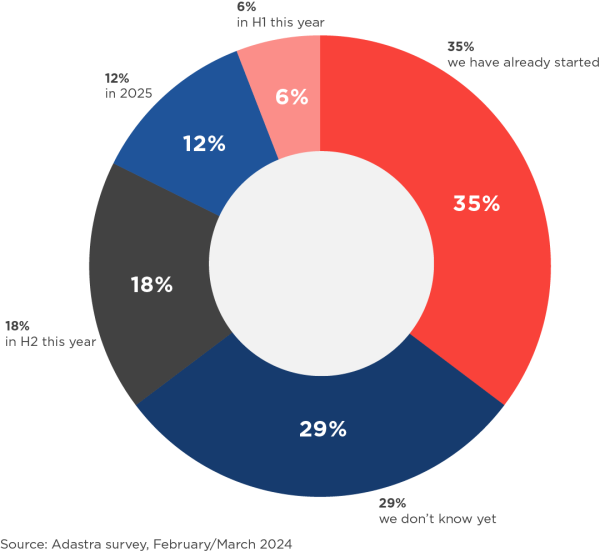
“A total of 35% of companies report that they have already started collecting and processing ESG data. For example, they use online dashboards, calculations, share data within the company and out to their suppliers. At the same time, they add that this is not yet a continuous activity. They are at the very beginning,” says Radim Petratur.
A total of 24% of companies are planning for continuous ESG data collection during this year, with another 12% planning for 2025. As many as 29% say that ESG reporting is addressed, but not at the level of data, but as a regulatory obligation. They have no plans to digitize ESG data yet.
The fact that Czech companies are at a very early stage of ESG data digitalization is underscored by the fact that most of those expected to begin reporting in 2025-2026 are still designing their strategy and do not yet know what to expect from digitalization.
Companies will have to get their ESG data in order
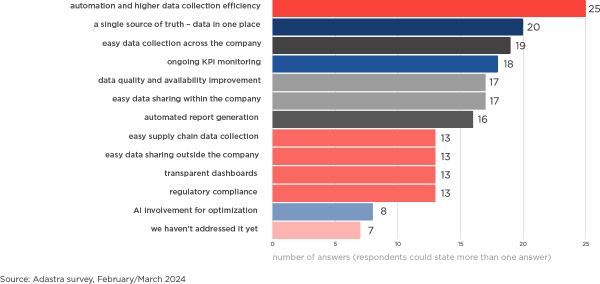
Companies that are planning or have already started to digitize are expecting automation and increased efficiency of ESG data collection. They want to have all data in one place – to get what is referred to as a single source of truth. Why?
“Because it will be easier for them to share the data. Both within the company, for example with other departments or management, as well as with their supply and customer chain,” explains Radim Petratur.
Moreover, the survey showed that it is important for companies to continuously monitor their performance against KPIs. They expect ESG digitalization to always be fully compliant with the legal framework and simplify the automatic generation of mandatory ESG reports.
“Ultimately, data will play a role. Because a good part of what companies will report is data. Their automated continuous collection and digitalization should therefore be step zero. Reports, visualization, analytics – all this can only follow when companies get their data in order,” says Radim Petratur.
We don’t know what we don’t know. The market lacks best practice.
Companies agree that there is still a lack of clear guidance on the ESG agenda in the market. “We don’t know what we don’t know. We are trying to define priorities, define the impact of ESG on business and identify resources,” the companies say.
Other challenges faced by companies include:
- Data collection, analysis and evaluation
- Motivating management and colleagues across the company
- Team coordination
A year ago, most companies agreed that they did not use any dedicated software tools to measure ESG goals. The situation has not progressed much in this regard.
Companies already know that data is the foundation, and they need to get it right. Quality data governance is then followed by dedicated ESG tools, whose time is yet to come.
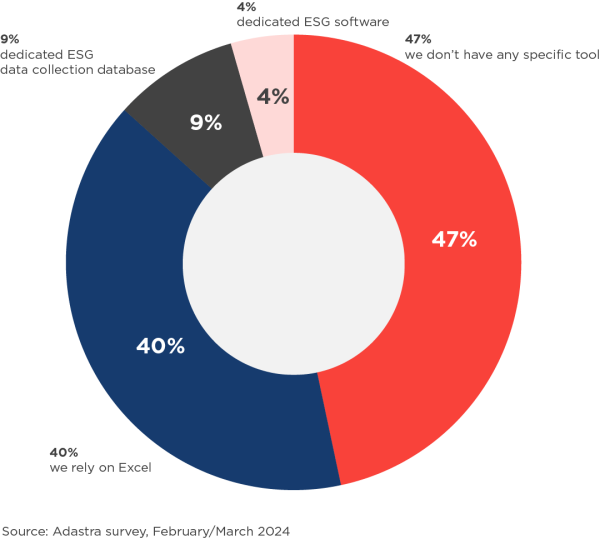
“As expected, a total of 47% of companies do not use any dedicated software yet. They have data all over the company and, as they say, their most common tools are paper and pencil,” says Radim Petratur. A total of 40% of companies still rely on Excel, while 9% use dedicated databases to collect ESG data. “Only 4% of companies have dedicated ESG software at the moment. There are already a number of good solutions on the market and companies will not be able to do without them in the near future,” adds Radim Petratur.