Insights
Fridges, Shelves, and Pallets Know Your Beer Choice: Adastra Lab Sensors Replace Intuition with Data-Driven Decisions
April 17, 2024
Sensors can measure any physical quantity. Today, they are more affordable, last longer, and easily connect to IoT networks. Adastra Lab demonstrates their widespread utility.
When Numbers Replace Intuition
It may seem that we live in a digital world where all business decisions are made based on precise statistics and graphs. However, the reality is that a significant portion of decisions are still made based on gut feelings, as pointed out by Petr Blabla, head of Adastra Lab. The success rate of such steps is not consistent—they may hit the mark, but they might not. The development of the Internet of Things (IoT) allows managers to replace intuition with precise data, even in areas where this was previously unimaginable, like supermarket counters.
The supermarket space is a highly competitive environment. Manufacturers compete for better placements of their products and invest in campaigns to get their new items as close as possible to the main arteries, where the most customers pass through. “For both manufacturers and retailers, the challenge is to maximize the return on substantial marketing investments. Both parties cannot determine whether the investment in better placement has paid off until they have precise data,” explains Petr Blabla, who leads Adastra Lab.
Adastra Lab is part of the technology company Adastra, which recently announced record revenues of 5.6 billion crowns. Adastra Lab specializes in the application of the so-called Internet of Things, primarily in retail and logistics. It has developed its own range of patented modular sensors that can collect a wide array of data across the furthest corners of the production and sales cycle.
IoT is Changing the Game in Supermarkets
Data from sensors are processed by a smart IoT platform, which visualizes them into clear dashboards. This provides retailers with real-time information on which they can base better business decisions, such as where to place their stands in the store. In its pursuit of the benefits of IoT technologies, Adastra also integrates other unique specializations such as artificial intelligence along with data and cloud solutions.
One of the first clients to demonstrate the power of the Internet of Things was a collaboration with Plzeňský Prazdroj. “Prazdroj was one of the first in the market to realize that information based solely on the experience of sales representatives was not sufficient for long-term success. They decided to supplement what they called ‘feeltology’ with real data,” explains Blabla about the beginning of the partnership.
Retailers did not know the exact answers to questions like how much space they should buy in the promotional area for a campaign introducing a new flavor. Will customers notice the new non-alcoholic beer right at the entrance of the store? And do they add products to their carts more from the “Beer” category shelves or are they more likely to grab bottles placed in fridges closer to the cash registers? The answers to these questions, which help companies increase sales, save costs, and improve customer experience, came from innovative solutions.
“For Prazdroj, we manufactured special smart stands, refrigerated shelves, and pallets that can track which products customers are buying from them. An infrared sensor at the front detects when a customer is near a promotional stand and measures how long they look at the products. Underneath the stand, there’s a smart scale which can determine from which position and what product the customer took,” describes Blabla the way his team decided to resolve the lack of data for decision-making. These shelves and scales have gradually appeared in 70 stores across the Czech Republic and Slovakia.
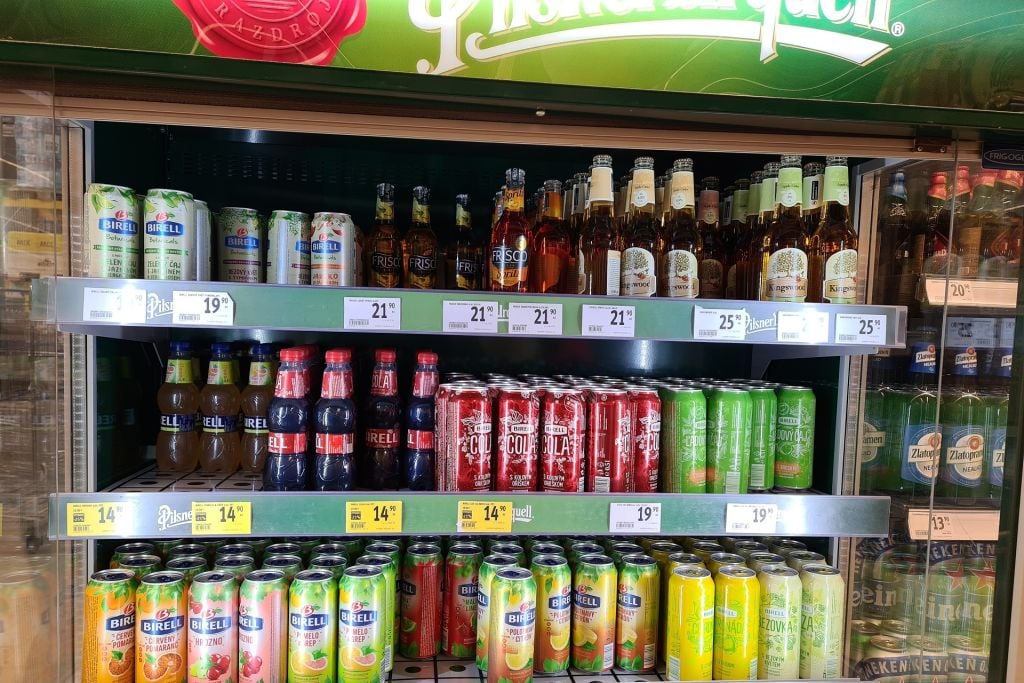
The prospect of a world where shelves know which beer a customer is buying might send chills down some spines. However, the smart infrared sensors do not collect personalized data and are in compliance with GDPR. They do not record video of what happens on the shelves, nor do they attempt to link anonymous customers with their identities. They only capture thermal images. Smart scales, on the other hand, only record weight changes when someone removes goods.
Adastra Lab also offers a ceiling sensor that captures customer movements across the floor from a bird’s-eye view. It can determine gender, height, and estimate the direction in which a customer is looking. The data from the sensor is processed by a smart IoT platform, and the retailer receives what is known as a heat map, which illustrates the path of customers throughout the store and shows the places where they spend the most time and where they shop.
“We are aware that customer sensitivity to cameras is quite high. That’s why we use non-invasive infrared sensors and sensors. The data from them are then transparently used to optimize and improve the customer journey,” explains Petr Blabla.
Relying on sensors brings unexpected challenges.
“Blind infrared sensors combined with smart scales provide a sufficient understanding of what is happening on the shelf. However, this also introduces a very delicate problem—unexpected phenomena. Fridges near cash registers often become the dumping grounds for items that customers decide to remove from their baskets at the last minute. For anomalies like placing a chicken in the fridge with beer, we had to create a special scenario to ensure our measurements were not misled,” explains Blabla.
For Anomalies Such As Placing a Chicken in the Fridge with Beer, We Had to Create a Special Scenario to Ensure Accurate Data Capture
Pallets and refrigerators equipped with sensors are not recognizable without detailed knowledge in the store, so they do not disturb customers during their shopping. Not every shelf in the store needs to be smart; for the sake of efficiency, it suffices to measure data on a representative sample. Data from the sensors are sent at regular intervals to the cloud, where a specialized platform retrieves and processes them further. The retailer then receives detailed information about the utility of each pallet, which allows for very precise decisions in arranging goods in the store. An additional benefit is information about stock levels and when items need to be replenished.
Prazdroj discovered through measuring the marginal utility of pallets that changing their placement in the store could increase sales by up to eleven percent. Data showed, for instance, that two pallets do not always sell double the amount. It depends on the arrangement of products in each position – instead of another pallet of premium beer, it might be more advantageous to give space to non-alcoholic beer. Surprisingly, designer stands in some locations sell up to twenty percent less than ordinary pallets but attract more impulse purchases.
“Improving customer experience in stores or showrooms is just one example of how we can provide precise answers to companies. In collaboration with technology partners in the hardware sector, such as the Liberec company Hardwario, Lesák, Gondella, Koncept 6, or the University of Pardubice, we have developed and patented our own devices that we can equip with various sensors, fit with batteries of different sizes, and use in diverse environments. We enjoy the practical application of technologies and are currently testing several new products that are missing in the market,” Blabla adds more examples of what Adastra Lab is currently working on.
Their technology finds use in logistics, for example, where sensors measure the temperature during the transportation of drugs or food, which must not undergo temperature shock. They also monitor the route of a package and check that it has not been opened or dropped unauthorized during transit. The added value of the technology is also found in the digitization of sustainability data. Among Adastra Lab’s clients are companies like LEGO, for which the team solved the optimization of customer experience in stores, as well as Coca Cola and, more recently, Mattoni.
IoT: An Old-New Concept
The roots of the Internet of Things (IoT) stretch back to the 1970s, but it was mostly discussed intensively about five years ago. Back then, futuristic predictions promised that by 2025, there would be over fifty billion IoT devices connected to the internet. However, the technology encountered a number of limitations—issues with chip production, energy-intensive operations, unstable connections—and so far, the number of connected devices is only a quarter of the original targets. Nonetheless, these problems are gradually being resolved, aided by the increased availability of technologies and the development of NB-IoT and 5G networks.

“The new GSM network standard offers not only better coverage but also a dedicated band for IoT devices, which can transmit data with minimal energy consumption. Thanks to our own firmware, we evaluate some of the information inside the sensor itself and do not send it further, while other parts are transmitted at regular intervals to maximize data traffic efficiency. An optimized data transmission tailored to the specific customer, along with the appropriate SIM card and battery, can ensure non-invasive operation for years without maintenance,” adds Blabla.
Refrigerators in Stores Are Selling 80% Less Than What Retailers Initially Estimated
Adastra Lab has successfully identified compelling deployments that demonstrate the real-world efficacy of the Internet of Things. Blabla considers this a pivotal moment: “Functionality wasn’t well-documented in practice, we lacked examples and case studies, and even forward-thinking companies lacked the arguments to invest in new technology.” The new generation of sensors, mobile networks, and the development of cloud and data platforms have radically changed the old order.
For instance, Prazdroj discovered that refrigerators in stores were selling 80 percent less than its merchants had intuitively estimated. Customers preferred to walk to their favorite lager located in a dedicated beer section rather than take a bottle from a chilled refrigerator. “Interestingly, the uptake from the fridges does not follow weather patterns or seasons,” adds Petr Blabla. The long-term goal of Plzeňský Prazdroj is “to place drinks exactly where customers expect them.”
The growing team at Adastra Lab, which includes about fifteen experts on the Internet of Things, hardware engineering, and mobile connectivity, aims higher. They want to leverage their experience gained in Central Europe in international projects and believe that the digital culture of companies is now at a level that they are ready to embrace high-tech solutions.
“The backing of Adastra Group gives us a significant advantage because we offer companies a patented range of smart sensors and an IoT platform combined with the expertise of top specialists in cloud integration and artificial intelligence deployment,” concludes Blabla.
The article was published on the CzechCrunch portal on April 9, 2024.