Insight
Government Agencies Leverage IoT Data to Enhance Efficiency and Insight into Recyclable Materials
June 20, 2024
What happens to plastic bottles after we throw them into sorted waste bins? The Ministry of the Environment in the Czech Republic, in cooperation with Adastra Lab, implemented a project using IoT to track the movement of sorted PET bottles. They aimed to verify the exact number of plastic bottles in the Czech Republic that are recycled and to use real data to enhance the entire recycling process.
Currently, only 75% of plastic bottles introduced to the market are sorted in the Czech system, but the goal is to reach 100%. To improve the recycling process, the Ministry of the Environment in the Czech Republic needed to determine the reality of the situation. “We wanted to find out what happens to PET bottles after we throw them into the yellow sorted waste bin and where they end up. Therefore, we tried to track 100 empty bottles,” says the Czech Minister of the Environment, Petr Hladík.
IoT Chips in Practice: A Visual Overview of Plastic Waste Movement in Real-Time
“We used custom-made IoT chips designed with environmental considerations, safety, and low costs in mind. They communicate with the IoT platform via wireless networks, allowing continuous tracking of the bottles’ position and status, providing a visual overview of bottle movement in real-time,” explains Adastra Lab CEO Petr Blabla.
Adastra Lab’s IoT solutions enable the tracking of goods and commodities over time and the optimization of the entire process based on the data. “Our goal is to participate in projects that make sense. We want to help with what we do best – collecting data and interpreting it. Thanks to this, not only the Czech Ministry of the Environment but any public or commercial entity can make better and more efficient informed decisions based on real data,” explains Petr Blabla.
IoT Project Results: Where Do Our Plastic Waste End Up?
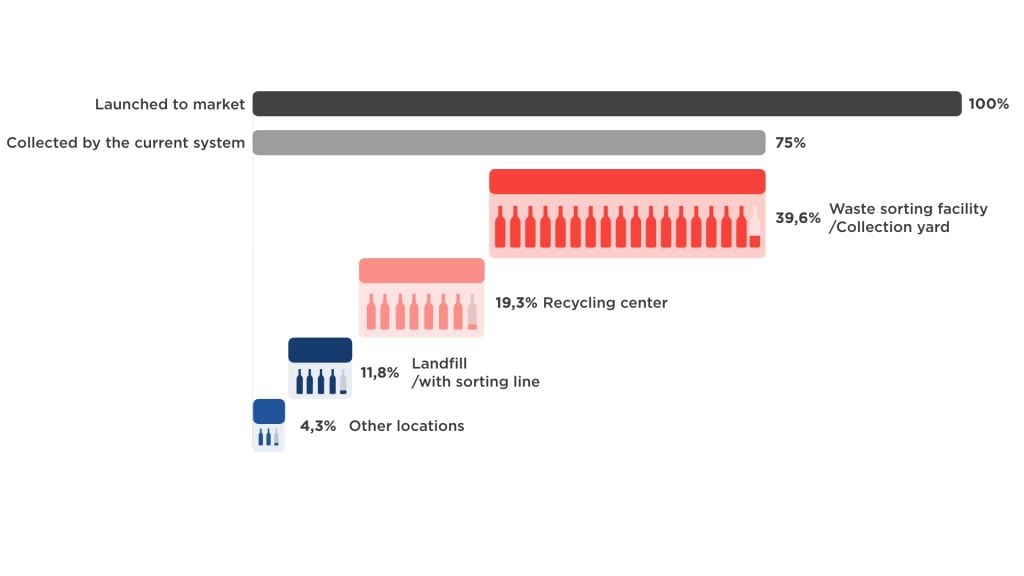
Only three-quarters of the plastic bottles that enter the Czech market end up in sorted waste. The goal is to sort all bottles in the future. To improve the recycling process, the Czech Ministry of the Environment needed to determine the real situation.
The Survey Revealed the Current State in the Czech Republic:
- 19.3% of PET bottles go to recycling centers
- 39.6% of PET bottles head to waste sorting facilities or collection yards
- 11.8% of PET bottles end up in landfills
- 4.3% of bottles end up in other locations (e.g., meadows, fuel stations, parking lots near family homes, etc.)
Almost one in ten PET bottles goes abroad – in this case to Slovakia and France.
Technical Insights: Tracking the Movement of Plastic Waste Using IoT Technology
To track the movement of sorted plastic bottles, 100 empty 0.7-liter PET bottles were fitted with advanced IoT tracking chips. These bottles were then disposed of in bins for sorted waste across the Czech Republic. Over a three-month period, analysts monitored their movement, with 70 bottles providing data for the entire duration.
GPS Tracking Chip
- Minimal environmental impact and project costs.
- Connected to an IoT platform for real-time visual overview.
- Safe and single-use sensor.
- Assembled only with the essential components to determine the location and send information to the cloud.
Battery
- Low-voltage battery with no specified transport restrictions.
- Primary (non-rechargeable) cell with non-flammable electrolyte compliant with IEC safety standards.
- Durable for the entire PET bottle processing cycle.
- Tested without damage in a press.
- No risk of explosion or fire.
Packaging Material
- The chips were wrapped to withstand the entire waste-handling process.
- They were inserted into standard PET bottles from Mattoni 1873.
Press Conference in Adastra CZ, June 6, 2024